|
LAMB arts is pleased to present the first solo show in London of leading Spanish painter, Francisco Nicolas.
In an age of increasingly sophisticated digital photography – not to mention increasingly numerous artistic media – Nicolas realises the age-old medium of painting he first adopted in the late 1970s at the Faculty of Fine Arts, University of Barcelona, must adapt and evolve to survive.
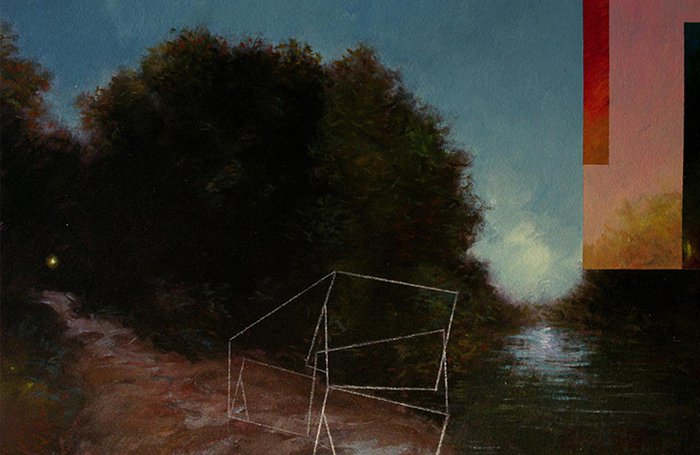
His work – commonly acrylic on canvas or wood – is inspired by the rich painterly tradition of his native Spain and various visits to the Prado, Museu Nacional d'Art de Catalunya and other museums to see the canvases of Velazquez, El Greco et al. Yet it’s the landscape genre, both the classical archetypes of Claude Lorrain and Romantic examples of early 19thcentury Germany, that are his preferred starting-point. In his subsequent artistic interferences, Nicolas conceives himself as a tiller or worker on that land, superimposing geometric abstract shapes on a given scene.
Timeless landscapes are duly augmented by squares, oblongs and triangles, at once eternal mathematical polygons but also unmistakable symbols in the history of art of hard-edged abstraction, firmly rooted in early 20th century culture.
This show features 25 acrylic works, all of which have been created in the last five years since Nicolas returned to health after a life-threatening illness. He says their musing on the nature of time has both aided his recovery and reflected it.
The range of heightened, non-naturalistic colours in Nicolas’s work is, in part, he says, a response to the magical explosion of colours that make up a sunset in much of the Iberian Peninsula. Yet they also represent Nicolas’s fondness for occupying artistic territory on the border of opposites: real / unreal, figurative / abstract, picturesque / geometric, classical / romantic, contemporary / traditional.
The final of these anthitheses is taken to its extreme in recent works such as Rocas, Casa de Dios and Insula VIII, in which Nicolas abandons paint altogether in favour of a camera and digitally processes his base image onto Fabriano paper – Fabriano being a town in the Italian region of the Marche, which owes its very existence to a large-scale paper industry dating back to the late-medieval and Renaissance period.
Occasionally, Nicolas’s shapes are tinted: transparent windows through which one can see the trees, hills and mountains beneath; in other works, they are so opaque as to occlude our view of the underlying scene entirely. A didactic, environmentalist message about the damage we are doing to nature and mother earth isn’t intended on the artist’s part so much as a suggestion of the recession of the past into both tinted memory and, ultimately, complete oblivion.
Since moving to London in 2012, Nicolas has shown work at the Royal Academy Summer Exhibition, as well as Pinta art fair and in two group shows at Maddox Arts gallery in Mayfair.
He cites Rene Magritte as perhaps the most significant influences on him, specifically the Belgian’s ‘Window’ paintings: depictions of landscape canvases on easel, in front of windows opening onto ‘real’ landscapes outside. Nicolas continues Magritte’s pursuit of questioning the old Renaissance assumption of painting as a window on reality, in simultaneously search for autonomy and ontological security.
|